
Gloucester City Directory Collections by Year
Gloucester city directories are dated snapshots, not annual censuses. They can connect a printed name, street, occupation or business description, and a particular edition, while leaving out children, some boarders, people who declined a listing, or people who moved after the canvass. The strongest starting point is the year-by-year NOBLE Digital Heritage collection. Sawyer Free Library says its digitized Gloucester run reaches from 1860 through 1993 with gaps. Gloucester Archives also directs researchers to directory material, while other repositories supply useful checks when a scan or year is absent.
| Collection | Years represented | Where held | How to use it |
|---|---|---|---|
| NOBLE digitized Gloucester city directories | 1860 through later decades, including early two-year editions | NOBLE Digital Heritage | Free year-by-year scans; use viewer search or page browsing |
| Sawyer Free Library directory run | 1860-1993, with gaps | Sawyer Free Library local-history resources | Digitized links, microfilm, research assistance, and related newspapers |
| Massachusetts State Library directory holdings | Selected editions from 1869 through 1970 | State Library collections | Coverage check; some listed holdings are microfilm |
| Cape Ann Museum research library | Incomplete 1860-1978 run | Cape Ann Museum | Complementary in-person research collection |
A missing year is a result, not proof of an empty address. The known run mixes single-year and two-year editions, and the State Library and museum holdings are valuable cross-checks. Copy the title page exactly, because a publication year, a canvass year, and a two-year edition label may not mean the same thing. Note: Gloucester’s digitized coverage reaches through 1993, but the final printed edition was not separately verified in the research.
Gloucester City Directories on the Local Shelf
The online collection is only one route into Gloucester city directories. Sawyer Free Library’s genealogy resources connect directory research with Gloucester Daily Times notices, deeds, yearbooks, local archives, vessel records, and microfilm. Its house-history guidance recommends making an appointment with the Local History Librarian when an address question needs maps, town records, or material that does not have a searchable scan. The library also identifies city engineers’ maps from around 1956, which can help reconcile an old directory street with later parcel geography.
The Gloucester Archives Digital Collections link directories alongside town, selectmen, vital, commoner, map, and vessel records. Many Archives holdings remain an in-person, microfilm, or finding-aid task. Current posted hours are Monday, Tuesday, Wednesday, and Friday from 9 a.m. to noon, with Thursday closed, and the Archives asks researchers to contact staff before traveling. The museum’s incomplete directory run sits beside annual reports, school reports, yearbooks, genealogies, and maritime material, so it is especially useful when a name has a local institutional or family-history connection.
The NOBLE Gloucester city-directory collection shows the sort of year selector and scanned pages a historical search requires.
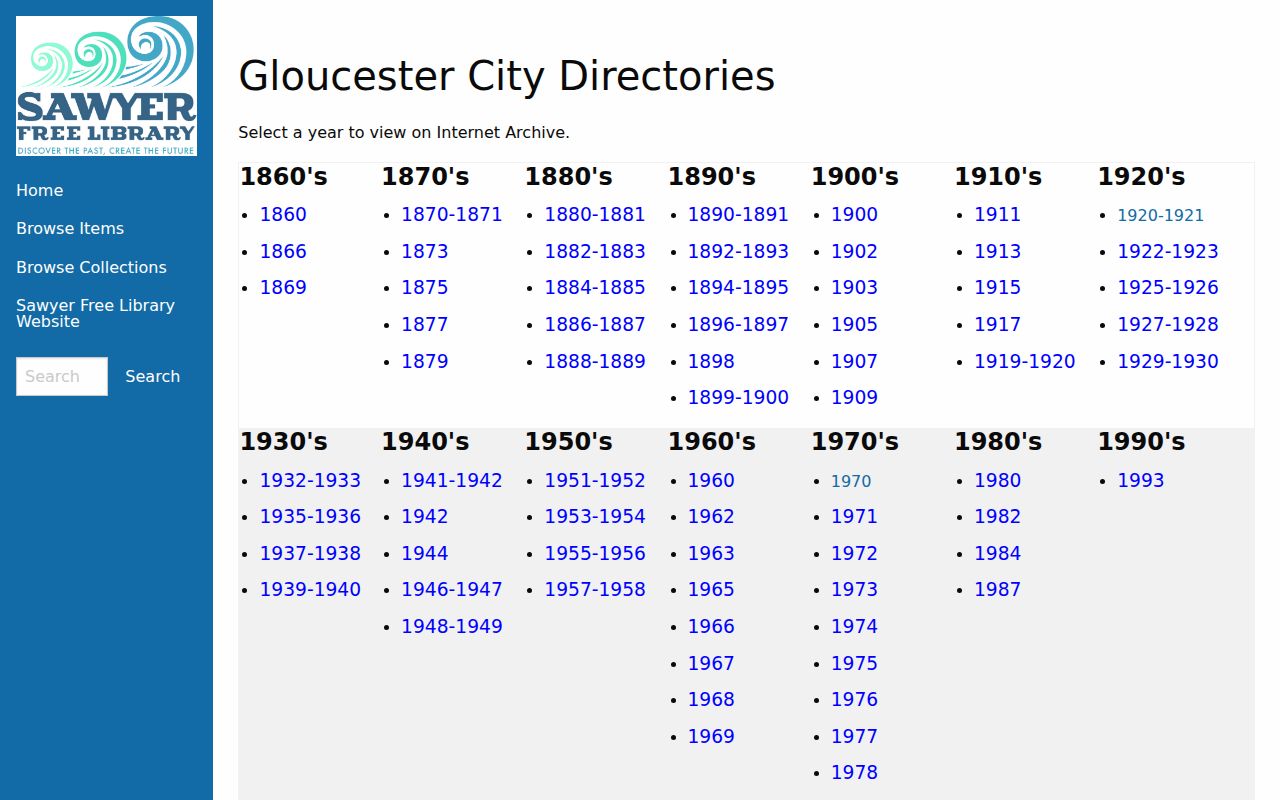
Start with the closest volume, then preserve its year, page, and stable item link with every transcription. OCR can misread nineteenth- and early-twentieth-century type, so an image check matters even when a search box finds the surname.
Gloucester Directory Editions and Gaps
The editions themselves reveal how much detail varies. The 1873 Gloucester volume includes a general directory, a business directory, city officers, banks, cemeteries, churches, and a section titled “Streets, Courts, and Places.” Early Gloucester imprints are associated with Procter Brothers in collection metadata, while the 1888-89 and 1890-91 volumes identify Sampson, Murdock and Co. of Boston. The research does not support assigning one publisher to every Gloucester volume. Read the title page for the edition in hand rather than carrying an imprint forward.
Village wording is another useful local index. Annisquam, Magnolia, Lanesville, East Gloucester, Rocky Neck, and other Cape Ann place names may appear under Gloucester, under a village convention, or in a post-office style. Search the general list, street material, and business or civic sections before deciding that a person is absent. A street can also appear as “Washington,” “Washington street,” or an abbreviation. Those differences are historical wording, not evidence of a move.
Coverage gaps deserve a research note. A gap between the 1869 and 1873 editions, or a span between two-year volumes, cannot establish that no household occupied the location. It may reflect a missing scan, a publication interval, or an edition that used a different compilation schedule. Note: A title-page imprint identifies that edition, not a publisher for every Gloucester directory year within the archival run.
Reading a Gloucester Directory Entry
A Gloucester city directory entry should be copied as a dated statement, not converted into a modern profile. The 1873 scan’s civic and general sections show why placement matters: a city-officer line, a business listing, and an alphabetical resident line may have different field patterns. Capture the printed spelling, initials or title, the stated address, the role or occupation when present, the page, and the exact volume. An occupation label can be abbreviated or outdated, so it is a clue to compare, not a conclusion by itself.
| Printed name | Preserve surname order, initials, honorifics, and spelling exactly as printed. |
|---|---|
| Address | Record the street wording and number without silently converting it to a current form. |
| Role or occupation | Note the wording and whether it appears in a general, business, civic, church, or institutional section. |
| Edition citation | Keep the title, year or year span, page number, scan image, and repository link. |
| Context check | Compare nearby editions, a deed, map, newspaper notice, or census before making an identity link. |
- Criss-cross trace
- A street-order method for linking an address back to names. A dedicated official Gloucester reverse directory was not located, so use street pages, OCR, and adjacent editions manually.
- Household convention
- Many historical entries represent a head of household. That convention does not establish every person living there or a family relationship.
- Abbreviation key
- Front matter and title pages can explain each volume’s shorthand. Photograph the key when one appears, because abbreviations may change across editions.
Searching Gloucester City Directories by Address
A manual address trace is the reliable substitute for a promised reverse lookup. First choose the closest directory year. Then use OCR, thumbnails, or page browsing for the street name and likely house number. Write down every person or business at that address in consecutive editions, and check whether the same printed name appears alphabetically at a different address. When the directory and a later source disagree, retain both dates rather than forcing one continuous story.
- Select the edition closest to the event, address, or known name.
- Search surname variants, initials, and the street with and without a modern suffix.
- Save each general, business, or institutional page that names the address.
- Compare the next and previous available editions for moves, spelling changes, and new entries.
- Check a deed, assessor record, map, newspaper, or voter list for a separate dated role.
The historic directory and the current property trail answer different questions. A deed records an instrument, an assessor record supports tax administration, and a directory records how an address or person was printed for that edition. For present-day address-keyed sources, use the Gloucester street directory rather than extending an old entry into a current-residence claim.
Gloucester Directory Village Names
Gloucester city directories gain value when a researcher keeps local geography intact. Planning material recognizes places including Downtown Gloucester, Annisquam, Bayview, East Gloucester, Eastern Point, Rocky Neck, Briar Neck, Lanesville, Magnolia, Riverdale or Dogtown, West Gloucester, Wingaersheek, and Pearce Island. A directory might use a street while a newspaper uses a village or point. The names should be searched as parallel terms, not treated as competing answers.
Building names can also matter. Gloucester Crossing illustrates how a named development can coexist with Schoolhouse Road and several building numbers. Search the building name, map and lot, older road name, and street number when a record does not line up at first. The City’s address-assignment file is a concrete example of why a number change may reflect an administrative assignment or a multi-building parcel instead of a household move.
Note: Preserve the spelling found in the historical volume, then record a normalized modern form separately for later searches.
Tracing Gloucester City Directory Households
For family history, follow a household through available directory years and use census releases to bridge wider intervals. Begin with the first confirmed printed appearance. Track address wording, initials, occupation labels, business names, and section placement forward and backward. A disappearance can signal a move, death, a changed listing convention, an omitted canvass, or simply a missing edition. It should lead to a second source, not a final answer.
- Locate the earliest confirmed Gloucester directory entry and cite its page.
- Follow the person or household through each nearby available edition, noting exact address changes.
- Search the street or “Streets, Courts, and Places” material for nearby address references.
- Pair directory dates with the appropriate released census, then compare names, ages, and place labels cautiously.
- Close a historic trail with a deed, newspaper notice, cemetery inscription, or a vital record from the custodian.
The Dolliver cemetery-inscriptions project can provide an additional nineteenth-century bridge. It establishes an inscription, not a residence. A matching directory address, vital record, or notice is still needed to distinguish people with the same surname.
Gloucester City Directory Dates That Matter
These dates help set realistic expectations for a Gloucester city directory search. They also show why a source can be visible online yet incomplete, or available in a repository but not instantly searchable.
- 1860: the earliest digitized Gloucester directory year identified in the collection run.
- 1873: Gloucester became a city, and the surviving directory volume includes streets, business, civic, and general sections.
- 1888-1891: collection metadata identifies Sampson, Murdock and Co. on the 1888-89 and 1890-91 editions.
- 1895-1938: Archives materials identify assessors’ returns arranged by ward and street, a separate historical people-and-address series.
- 1993: Sawyer states digitized directory coverage through this year, with gaps.
Repository conditions also change. The 2025 Sawyer renovation and History Center planning notes, along with Gloucester Archives records-management work, mean a directory, newspaper reel, manuscript, or assistance appointment may have a different access route than an older catalog entry suggests. Confirm whether a needed item is digitized, on microfilm, in-library, available by appointment, or still being arranged before visiting.